
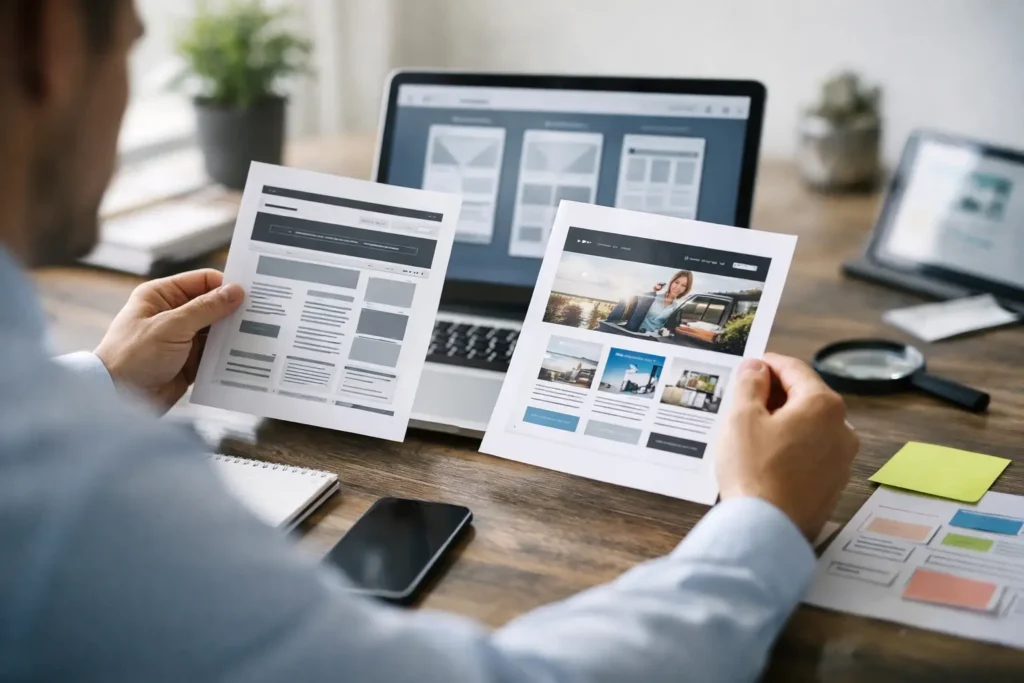
A website can look polished and still be costing the business opportunities. Slow enquiries, weak search visibility, confused visitors and a brand that no longer reflects the quality of your work are not minor issues to patch around. The question of when should you redesign your website is less about following a fixed timetable and more about recognising when the site is no longer helping the business move forward.
A considered redesign is not simply a new colour palette or a more modern homepage. It is a chance to improve how your brand is understood, how easily people find what they need and how effectively the site turns attention into action.
When should you redesign your website?
Redesign your website when there is a clear gap between what your business needs to achieve and what the current site can support. That gap may be commercial, technical, visual or strategic. Usually, it is a combination of all four.
For a growing business, a website that once did the job can quickly become a constraint. Services expand, audiences change, competitors improve their digital presence and customers expect more confidence from every interaction. A redesign becomes worthwhile when refining individual pages will not solve the underlying problem.
1. Your brand has moved on, but your website has not
Your website is often the first proper interaction a prospective client has with the business. If it presents an old logo, inconsistent messaging, dated imagery or a visual style that no longer matches your positioning, it creates doubt before a conversation starts.
This is especially common after a rebrand, a move into higher-value work or a change in target market. A professional services business may have developed a more specialist offer. A startup may have found its place in the market. A creative brand may now produce work at a level its original website does not communicate.
The issue is not whether the site feels old to you. It is whether it accurately signals the standard, clarity and ambition of the business now. If it does not, a redesign can bring brand strategy, content and digital experience back into alignment.
2. Visitors struggle to understand what you do
A website should make its purpose clear quickly. Visitors need to know what you offer, who it is for and what to do next without working through vague statements or overloaded menus.
If sales calls regularly begin with basic clarification, or prospects arrive with a poor understanding of your services, the website may be creating friction rather than reducing it. The same applies when a business has added services over time and the navigation has become a collection of disconnected pages.
A redesign can simplify the information architecture. That means organising services around how customers think, giving priority to the pages that matter commercially and creating clearer paths towards an enquiry, booking or purchase. Good design is not decoration placed over confusion. It gives the right information a logical order.
3. Your site does not work well on mobile
Mobile is not a secondary version of the experience. For many audiences, it is the first one. A site that requires pinching, zooming, excessive scrolling or awkward form-filling will lose people before its value has been understood.
Signs of a mobile problem include buttons that are difficult to tap, text that feels cramped, images that dominate the page without adding meaning and navigation that becomes frustrating on a smaller screen. Slow mobile loading can make the problem worse, particularly for visitors arriving from social posts, local search or paid campaigns.
A proper redesign addresses mobile from the start rather than attempting to force a desktop layout into a narrow screen. It considers hierarchy, interaction, content length and conversion points in the context in which people are actually using the site.
4. Enquiries or sales are underperforming
Traffic is useful only if the right visitors can take the next step. If people are reaching the site but not enquiring, booking, subscribing or buying, the issue may sit in the user journey rather than the marketing channel.
Look beyond headline traffic figures. Are key service pages being viewed but producing few contact form submissions? Are visitors leaving after the homepage? Do case studies fail to explain outcomes? Is the call to action buried beneath generic copy? These are practical clues.
A redesign can improve conversion by clarifying propositions, strengthening trust signals, simplifying forms and creating more intentional page journeys. It cannot compensate for an offer with no demand, but it can stop a capable business from losing qualified leads through avoidable friction.
A website redesign is often an SEO decision too
Search performance should be part of the decision, not an afterthought. If your website has thin service pages, weak page structure, duplicated content, poor mobile usability or slow loading times, it may struggle to earn and retain visibility.
That does not mean every decline in rankings requires a complete rebuild. Content improvements, technical fixes and better internal structure can often produce meaningful gains. But if the site is built on an inflexible platform, lacks a sensible content framework or makes optimisation difficult, redesigning may be the more efficient route.
The trade-off is that a redesign carries SEO risk if it is handled carelessly. Existing URLs, page titles, valuable content and redirects need to be planned properly. Removing pages without understanding their search value can erase visibility that took years to build. The goal is not to start again for the sake of it. It is to preserve what works while building a stronger foundation.
5. Updating the site has become slow or expensive
A business should be able to update essential content without turning a small change into a technical project. If adding a case study, changing a service, publishing insight or updating a team profile requires repeated developer intervention, the website may no longer support the pace of the business.
This is often a platform or build-quality issue. Template-led sites can become restrictive when a brand needs more control, while older custom builds may be difficult to maintain if they were not designed with future growth in mind.
A redesign is an opportunity to define what needs to be editable, what should remain protected and how the site will evolve. The answer is not to make every element editable. Too much freedom can damage consistency. The right system gives your team control over regular content while protecting the quality of the design.
6. The technology is becoming a liability
Outdated plugins, unsupported software, unreliable hosting, broken integrations and security warnings are not merely technical housekeeping concerns. They affect trust, performance and the ability to run marketing activity with confidence.
If the website frequently breaks after updates, cannot integrate properly with your CRM or booking tools, or has become difficult to secure, a rebuild may be more sensible than a series of temporary repairs. This is particularly true where the site handles customer data, payments or high volumes of enquiries.
Before committing, assess whether the problem is contained or structural. Replacing a failing plugin is different from working around an ageing platform with no clear upgrade path. A clear audit prevents a redesign budget being spent on aesthetics when the real priority is technical stability.
7. Your competitors are setting a stronger standard
Competitor research should not lead to imitation. It should reveal the expectations your audience has learned to associate with the sector. If competing businesses communicate their expertise more clearly, present stronger proof or make their services easier to navigate, your site may feel less credible by comparison.
The opportunity is to identify the gaps they have missed. Perhaps their sites look similar but lack personality. Perhaps they offer information but no clear route to enquiry. Perhaps they have invested in appearance but overlooked accessibility, speed or useful case studies.
A redesign should sharpen your distinction, not make you look like the latest version of everyone else.
8. You have changed the business model or audience
New markets, revised pricing, additional locations, a move from direct-to-consumer to business-to-business work, or a more focused service offer all change what the website needs to do.
An old site may still describe the business accurately in fragments, but not strategically. It might give equal weight to services you no longer want to sell, attract the wrong type of enquiry or fail to speak to the decision-makers you now need to reach.
This is one of the strongest reasons to redesign because it begins with positioning. The right process defines audience needs, priority offers and commercial goals before visual directions are explored.
Do not redesign simply because the site is a few years old
There is no universal expiry date. A well-built website can remain effective for several years when it is maintained, measured and improved. Equally, a site launched 18 months ago may need rethinking if the business has changed significantly or the original strategy was weak.
Avoid treating redesign as a cosmetic cycle. If the structure works, the brand is current, the site performs well and visitors convert, targeted optimisation may offer a better return. Improve key pages, refresh imagery, add stronger proof and resolve technical issues before assuming a full rebuild is necessary.
The stronger case for redesign appears when several problems connect: the brand feels misaligned, the customer journey is unclear, mobile performance is weak, updates are difficult and results have stalled. At that point, isolated fixes tend to create more inconsistency.
What to establish before the redesign begins
A successful redesign starts with decisions, not visuals. Establish what the website must achieve in the next 12 to 24 months, which audiences matter most and what a valuable conversion looks like. For one business, that may be a consultation request. For another, it may be a qualified quote, a product purchase or a booking.
Review existing data alongside direct customer insight. Analytics can show where visitors leave; sales teams can explain the questions prospects repeatedly ask. Together, they reveal what content and journeys deserve attention.
Then set realistic measures for success. Faster load times, more qualified enquiries, stronger visibility for core services and reduced drop-off on key pages are all more useful than simply saying the site should look better. The visual standard matters, but it should support a defined commercial purpose.
A website redesign is at its best when it makes the business easier to understand, easier to trust and easier to choose. If your current site is failing on those points, it is not just ready for a refresh. It is ready for a more purposeful role in your growth.