A burst pipe at 7am does not create a leisurely research session. The customer searches, scans a handful of results, and calls the plumbing business that looks capable, nearby and easy to reach. Effective web design for plumbers is built around that moment. It needs to establish trust quickly, explain the service clearly and remove every obstacle between a local search and a booked job.
For an independent plumber or growing plumbing firm, a website is not simply a digital brochure. It is a sales asset working beyond office hours. Done properly, it supports local visibility, makes the business feel established and gives customers confidence before the first conversation takes place.
What web design for plumbers needs to achieve
A strong plumbing website has a practical job: help the right customer take action. That may be an emergency call-out, a boiler repair enquiry, a bathroom installation consultation or planned maintenance for a landlord or commercial property manager. These visitors have different priorities, but each needs a clear route forward.
The site should answer the questions people ask in seconds: What services do you offer? Which areas do you cover? Are you available now? Can I trust you in my home or premises? How do I get in touch?
Design is central to answering those questions. A polished visual identity, purposeful page structure and considered wording signal care before a visitor reads a full sentence. Conversely, an outdated template, grainy imagery or cluttered navigation can make even a highly skilled plumber look less credible than a competitor with a more professional presentation.
The objective is not to cram every service, accreditation and offer onto one screen. It is to create hierarchy. Emergency work may deserve immediate prominence, while larger installation projects need enough space to show quality, process and proof. The right balance depends on the work the business most wants to win.
Start with the calls your business wants
Many plumbing websites fail because they are designed around a generic service list rather than commercial priorities. Before choosing layouts or colours, identify the jobs that matter most. A sole trader focused on rapid-response repairs will need a different website from a plumbing and heating company pursuing high-value bathroom refurbishments.
A useful starting point is to separate services by customer intent. Urgent repairs require a direct phone number, visible availability and a short explanation of the response area. Planned work benefits from project photography, clear service pages and a simple estimate request form. Commercial customers may need evidence of reliability, maintenance capability and a professional process before they enquire.
This decision shapes the whole site. If boiler servicing is a core revenue stream, it should not be buried beneath a vague heading such as “general plumbing”. If bathroom installations are the growth area, the website needs to show the finish, not merely state that the service exists.
The pages that turn visits into enquiries
The homepage should provide a sharp overview, but it cannot carry the entire website alone. Dedicated pages give visitors relevant information and give search engines a clearer understanding of what the business offers.
A well-structured plumbing website will usually include focused pages for key services, supported by an area coverage page and a contact page designed for action. Each service page should explain the problem it solves, the type of customer it serves and what happens next. It should also include a consistent call to action, whether that is calling for urgent help or requesting a quote.
For example, a page for leak repairs should lead with the urgency of the issue and make the contact option impossible to miss. A page for bathroom plumbing can take a more considered approach, showing past work, outlining the scope of service and setting expectations for an initial discussion.
Avoid thin pages created only to target place names. Location-specific content should be useful and truthful. If a plumber regularly serves Rochdale, Oldham, Bury or the wider Greater Manchester area, the website can make those areas clear while explaining practical details such as call-out coverage and response times. Repeating the same paragraph with swapped town names adds little value for customers or search performance.
Trust is the most valuable design element
Plumbing is a trust-led service. Customers are often inviting someone into their home at a stressful moment, so reassurance should be built into the experience rather than added as an afterthought.
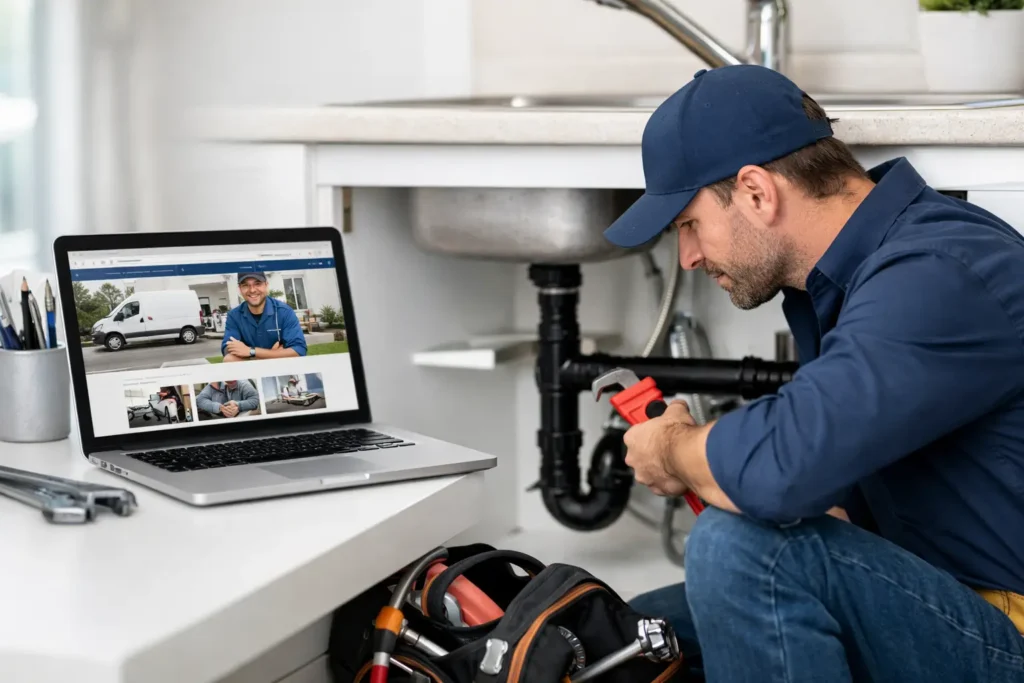
Clear contact details, a recognisable business name and genuine photography all help. Real images of the team, vehicles, workmanship and completed installations are far more convincing than stock photographs of a person holding a spanner. They make the business memorable and show that there is a real operation behind the website.
Accreditations, insurance details and review highlights can also support credibility when presented cleanly. The key is relevance. A wall of small badges is difficult to read and can feel defensive. Select the proof that matters to the customer, give it room to breathe and place it near decision points such as enquiry forms and service descriptions.
Testimonials should be specific where possible. A comment about punctuality, tidy work or resolving a difficult fault carries more weight than a generic five-star statement. For larger projects, a short case study can show the original challenge, the work completed and the outcome without overcomplicating the page.
Make mobile users the priority
Most urgent plumbing searches happen on a mobile phone. That makes mobile performance a commercial requirement, not a technical extra. A visitor should be able to call the business with one tap, understand the service without pinching and zooming, and submit an enquiry without fighting a lengthy form.
Good mobile design uses large, legible type, clear spacing and buttons that are easy to press. Navigation should remain simple. A customer with a leaking ceiling does not need six menu levels or an animated introduction. They need confidence, a phone number and a fast path to help.
Speed matters too. Heavy imagery, unnecessary effects and poorly managed third-party tools can slow a site down, particularly on mobile data. High-quality project imagery is valuable, but it must be prepared properly so visual impact does not come at the cost of usability.
Accessibility is part of the same thinking. Strong colour contrast, meaningful headings and straightforward language make a site easier for everyone to use. They also create a more considered, professional experience.
Build local visibility into the structure
Search engine optimisation works best when it is part of the website build, not a layer applied at the end. A plumber needs pages that reflect real services, real locations and the language local customers use when looking for help.
That does not mean forcing search terms into every sentence. It means creating clear page titles, well-written service content, logical internal structure and technically sound foundations. Search engines need to crawl and understand the website, while people need to find an answer quickly. Those two requirements usually support each other.
A thoughtful local strategy can also include pages for priority service areas where there is genuine demand and relevant content to share. The best approach depends on the company’s coverage, team capacity and growth plans. A business that can reliably reach several towns should communicate that breadth. One serving a tighter radius should be specific rather than making promises it cannot keep.
Treat the enquiry journey as a design problem
Every detail between landing on the page and making contact affects conversion. The phone number needs to remain visible. Forms should ask only for information needed to respond. Confirmation messages should set expectations, especially if enquiries are handled during working hours rather than around the clock.
It is also worth distinguishing emergency and non-urgent routes. A prominent call button suits immediate problems, while a concise form is often better for quotes and planned work. Combining both on key pages gives customers a choice without creating friction.
Measurement then closes the loop. Tracking calls, form submissions and the pages that generate them shows which services are creating demand. Over time, the website can be refined around real behaviour rather than assumptions. This is where custom design earns its value: it can evolve with the business instead of being constrained by a generic template.
A website that reflects the standard of your work
The best plumbing websites feel calm, capable and direct. They do not rely on gimmicks, overworked graphics or vague claims. They show customers what the business does, why it can be trusted and how to take the next step.
For plumbers competing across busy local markets, that clarity can be the difference between being another result in a search list and becoming the business a customer calls first. DBL Designs approaches that challenge by aligning brand, user experience, technical performance and local visibility in one focused build. Make the website reflect the standard of work customers can expect when you arrive.